



ASUS Republic of Gamers arrived at Gamescom 2026 with a very familiar message: faster is better. But this year’s wave of ROG gear is not just about pushing headline specs into absurd territory. It is also about giving competitive players more control over the things that can make a real difference in daily use – monitor positioning, mouse weight, keyboard feel, network prioritization, and even the way a controller’s buttons respond.
The centerpiece is hard to miss. ASUS has unveiled the ROG Swift OLED PG259QWS Ace, a 24.5-inch esports monitor with a claimed 720Hz refresh rate and 0.02ms response time. That makes it the company’s fastest OLED gaming display so far, and ASUS says it will serve as the official esports monitor for the 2026 PGL CS2 Major. The monitor is aimed squarely at serious Counter-Strike and FPS players, where frame rates, motion clarity, and consistency matter far more than 4K resolution.
It is the kind of product that will immediately invite the obvious question: who actually needs 720Hz? For most people, nobody. Modern games need to run at an extremely high and steady frame rate before a display like this begins to make practical sense, which generally means esports titles played on very powerful PCs. Still, competitive hardware often develops this way. What starts as a top-tier niche feature can slowly become more accessible, while the underlying panel, cooling, and input-response improvements benefit the wider monitor lineup.
ASUS is at least treating the monitor as more than a speed test. The PG259QWS Ace includes a built-in position sensor that reports the screen’s tilt, swivel, and height settings on-screen. It may sound like a minor detail, but tournament players can be extremely particular about their setup. Being able to recreate the same monitor angle and height after traveling to a live event is a genuinely thoughtful feature, rather than another RGB lighting trick.
The company also announced two more 24.5-inch OLED esports models. The ROG Strix OLED XG259QDPG Ace goes with a 560Hz QD-OLED panel, while the XG259QDNS Ace brings the formula down to 360Hz. Both use ASUS’ BlackShield Film and an anti-glare, low-reflection coating, which the company says can improve perceived black levels and make the screen easier to use under bright lights. That matters more in tournament environments than in a dark home office, but it is welcome on any glossy OLED panel that has ever doubled as a mirror.

Beyond the pure esports screens, ASUS is also experimenting with a more flexible idea: one monitor that can change personality depending on the game. The ROG Strix XG27UCMG is a 27-inch 4K display that can run at 4K and 240Hz, QHD and 400Hz when overclocked, or Full HD and 488Hz when overclocked. That means a player could use high-resolution 4K for cinematic single-player games, then switch to a lower-resolution, higher-refresh mode for multiplayer shooters.
The ROG Strix XG27ACNS takes that same triple-mode concept even further for players who prioritize speed. It offers QHD at up to 475Hz, Full HD at 620Hz, or HD at a remarkable 920Hz. The real-world appeal of that last number will depend heavily on image quality and the ability of a PC to feed it enough frames, but the broader point is clear: gaming monitor makers are increasingly moving away from the idea that one fixed resolution and refresh rate should suit every genre.
More personal peripherals
ROG’s peripherals are arguably the more relatable part of the launch. High-end displays can be aspirational purchases, but a mouse or keyboard is something gamers interact with for hours every day. ASUS is leaning into that personal connection with products designed to be adjusted rather than simply used out of the box.
The ROG Gladius IV Ace is a new 56-gram ergonomic wireless mouse with modular weights, seven possible weight configurations, an AimPoint Pro 65K sensor, and an 8K wireless connection through ROG’s SpeedNova 8K Gen II technology. ASUS also says it has been developed with input from esports players and sports-science testing intended to reduce strain during repetitive movements.

The useful bit here is not the 65,000dpi figure – virtually no one plays at anything close to that sensitivity – but the combination of low weight, shape, adjustable balance, and browser-based configuration. The latter comes through ROG Gear Link, which lets users change settings without installing a separate utility. Anyone who has accumulated a folder full of peripheral software just to adjust a DPI setting will understand why that is appealing.
For MMO players and anyone who likes a mouse covered in shortcuts, ASUS also introduced the ROG Spatha X 65K. It has 12 programmable buttons, interchangeable switches, five weight-and-balance configurations, tri-mode connectivity, and a magnetic charging dock that also works as a wireless receiver and display stand. It is very much the opposite of the minimalist Gladius: larger, more configurable, and built around keeping abilities and macros within reach.

There is a similar divide in the keyboard lineup. The ROG Strix Morph 96 X Wireless is a 96% custom mechanical keyboard with hot-swappable ROG NX V2 switches, a south-facing PCB for broader keycap compatibility, a gasket-mounted design, sound-dampening layers, a detachable wrist rest, and tri-mode connectivity. It also supports macOS and includes Mac shortcuts on its function row, a small but welcome nod to people who game on a Windows PC but work from a Mac.

Meanwhile, the ASUS TUF Gaming K4 Magnetic takes the magnetic-switch route, with adjustable actuation from 0.1mm to 3.3mm, Rapid Trigger support, an 8,000Hz polling rate, and hot-swappable switches. These features are increasingly common in keyboards built for competitive shooters, where players want keys to activate quickly and reset immediately when released. The TUF model also brings a gasket mount, five-layer dampening, PBT keycaps, and a volume knob, suggesting ASUS is trying to make it pleasant to use outside a ranked match as well.

A controller and soundbar join in
ASUS is not limiting itself to the mouse-and-keyboard crowd. The ROG Raikiri II Pro PC controller is built around TMR hot-swappable joysticks, which are designed to help avoid stick drift, along with 8K polling in wired and 2.4GHz modes, dual-mode triggers, micro-switch buttons, configurable rear controls, and a color display for quick changes to profiles, lighting, and vibration. ASUS rates the battery life at up to 79 hours in 2.4GHz mode.
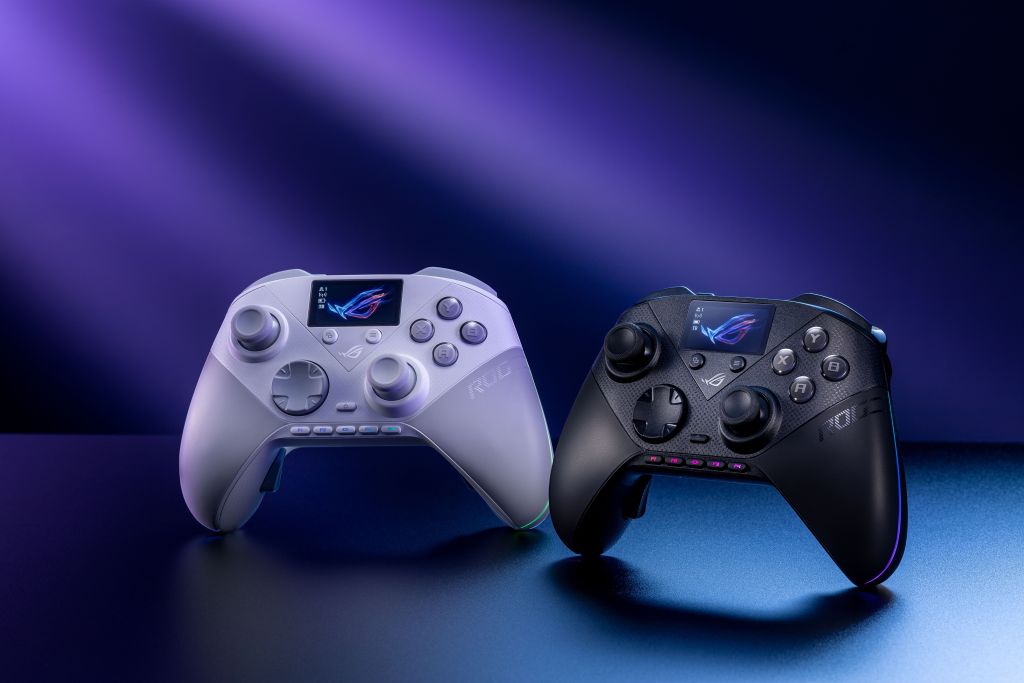
It is a feature-heavy controller, but the hot-swappable stick modules may be its most compelling selling point. Stick drift has become one of the most frustrating long-term problems in modern controllers, so a design that lets users replace modules instead of replacing the whole device makes sense – especially for premium hardware.
The ROG Gjallar gaming soundbar is the more unusual announcement. It pairs a soundbar with a wireless subwoofer and supports Dolby Atmos, while also including built-in microphones with acoustic echo cancellation for voice communication. It is designed as a hub for gaming and entertainment devices, which reflects how many PC setups have evolved into all-purpose screens for games, streaming, music, and video calls.
WiFi 8 enters the chat
Networking usually does not get the same attention as a new monitor or mouse, yet it can be one of the least glamorous sources of gaming frustration. ASUS is using Gamescom to push its first WiFi 8 gaming router, the ROG Rapture GT-BN98, which it describes as a quad-band model with up to 25,000Mbps throughput, dual 10GbE ports, four 2.5GbE ports, AI Game Boost, and tools that monitor interference and steer traffic toward more reliable paths to game servers.

The major caveat is that networking standards take time to reach real-world usefulness. A router can support the latest WiFi generation, but users still need compatible client devices, a capable internet connection, and a home setup that actually benefits from it. The GT-BN98 is clearly aimed at enthusiasts with multi-gigabit internet, gaming PCs, NAS hardware, and a house full of connected devices – not somebody looking to improve a basic broadband plan.

ASUS is also offering a WiFi 8 mesh option with the ZenWiFi BN12. The company claims tri-band speeds of up to 19,000Mbps, coverage up to 7,000 square feet, dual 10GbE ports, and Smart AiMesh features designed to coordinate multiple access points. It is not branded as ROG hardware, but it fits the same broader theme: gaming performance is now tied to the entire home network, not just the PC sitting on the desk.

Special editions and portable graphics
There is also some fun, collector-focused hardware in the mix. ASUS collaborated with League of Legends world champions T1 on GeForce RTX 5070 and RTX 5060 Ti special-edition graphics cards, using the team’s black, red, and white visual identity along with player graphics and a mech-inspired design. ASUS is also launching a TUF Gaming Radeon RX 9070 XT Onimusha Special Edition, developed with AMD and Capcom and styled around Onimusha: Way of the Sword.
These are clearly products for fans who want their build to feel like a display piece, not just a collection of components. The practical GPU performance will naturally matter most, but themed graphics cards have become a way for PC makers to tap into gaming culture in a much more visible way than a logo printed on a box.
One of the more interesting products from a practical perspective is the ASUS XG Core external graphics card. It places an AMD Radeon RX 9060 XT LP with 16GB of GDDR6 memory into a compact enclosure roughly the size of a hardcover book, using USB-C 40Gbps connectivity. ASUS says it can support 1440p gaming at more than 60 frames per second while also providing 406 TOPS of INT4 AI performance for local AI workloads such as image generation and large language model use.


That puts it at the intersection of two fast-growing needs: portable gaming power and local AI acceleration. For users of handheld PCs, mini PCs, or thin laptops, an external GPU that is genuinely compact could be more interesting than another massive desktop graphics card. Of course, actual performance will depend on the host device, its USB implementation, the game, and the inevitable bandwidth limitations that come with external graphics connections.
A 20-year milestone
Gamescom 2026 is also a birthday party for ROG, which ASUS says is marking its 20th anniversary. The company has paired the product announcements with the ROG Edition 20 lineup, a charity auction in support of SpecialEffect, and an “Upgrade What Matters” campaign running through December 31, with giveaways and promotions focused on gaming, content creation, AI, and general-purpose PC configurations.
The announcement is broad because ROG itself has become broad. It is no longer just a badge on a motherboard or gaming laptop. ASUS is trying to position it as an ecosystem that spans the visual, physical, acoustic, and networking sides of a gaming setup – from the monitor refresh rate and mouse click to router traffic management and a themed graphics card inside the PC.
For most gamers, the 720Hz OLED monitor and WiFi 8 router will remain expensive curiosities for a while. But the larger direction is easier to see. ASUS is betting that the next generation of gaming gear will not be defined by raw specs alone. It will be defined by how easily players can tune their setup around the games they play, the space they have, and the small preferences that make a desk feel like their own.
Discover more from GadgetBond
Subscribe to get the latest posts sent to your email.


